SRI PADAYA
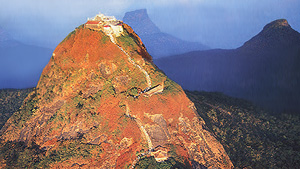 Mount Sinai was considered sacred at a much earlier date, Mt. Fuji surpasses it in beauty and height, and Mt. Kilash evokes a far greater sense of mystery. Nevertheless, no other mountain has been revered by so many people, from such a variety of religions, for so many centuries as Sri Pada has. In Sanskrit literature Sri Pada is called variously Mount Lanka, Ratnagiri (Mountain of Gems), Malayagiri or Mount Rohana. This last name, like its Arab and Persian equivalent, Al Rohoun, is derived from the name of the south western district of Sri Lanka where Sri Pada is situated. In several Tamil works it is known as Svargarohanam ( The Assent to Heaven) while the Portuguese called it Pico de Adam and the English Adam's Peak. In the Mahavamsa, the great chronicle of Sri Lanka written in the 5th century CE, it is called Samantakuta ( Samanta's Abode) while in modern Sinhalese it is often called Samanelakhanda (Saman's Mountain). Long before Buddhism came to Sri Lanka in about 246 BCE Sri Pada was revered as the abode the god called Samanta, or sometimes Saman or Sumana. This local mountain god was destined to go on to great things. The Theravada Buddhists of Sri Lanka later made Samanta the guardian of their land and their religion. With the rise of Mahayana Buddhism, a movement that began in south India from where it soon spread to the island, Samanta developed into Samantabhadra, one of the four principle bodhisattvas of Mahayana. Like his later manifestation, Samanta is usually depicted crowned and bejewelled, holding a lotus in his right hand and accompanied by a white elephant. At Weligama, an ancient port on Sri Lanka's south coast, there is a 12 ft high statue of Samantabhadra carved out of a huge moss-covered bolder. Pilgrims from India and northern Sri Lanka disembarking at Weligama were greeted by this bodhisattva's serene countenance as they set out on the long trek to Sri Pada. Today there is still a shrine to Samanta on the top of the mountain and another larger one near Ratnapura, some 19 kilometres from its foot. The name Sri Pada, while correctly referring only to the sacred (sri) footprint (pada) on its summit, is the most commonly used name for the mountain today. Mount Sinai was considered sacred at a much earlier date, Mt. Fuji surpasses it in beauty and height, and Mt. Kilash evokes a far greater sense of mystery. Nevertheless, no other mountain has been revered by so many people, from such a variety of religions, for so many centuries as Sri Pada has. In Sanskrit literature Sri Pada is called variously Mount Lanka, Ratnagiri (Mountain of Gems), Malayagiri or Mount Rohana. This last name, like its Arab and Persian equivalent, Al Rohoun, is derived from the name of the south western district of Sri Lanka where Sri Pada is situated. In several Tamil works it is known as Svargarohanam ( The Assent to Heaven) while the Portuguese called it Pico de Adam and the English Adam's Peak. In the Mahavamsa, the great chronicle of Sri Lanka written in the 5th century CE, it is called Samantakuta ( Samanta's Abode) while in modern Sinhalese it is often called Samanelakhanda (Saman's Mountain). Long before Buddhism came to Sri Lanka in about 246 BCE Sri Pada was revered as the abode the god called Samanta, or sometimes Saman or Sumana. This local mountain god was destined to go on to great things. The Theravada Buddhists of Sri Lanka later made Samanta the guardian of their land and their religion. With the rise of Mahayana Buddhism, a movement that began in south India from where it soon spread to the island, Samanta developed into Samantabhadra, one of the four principle bodhisattvas of Mahayana. Like his later manifestation, Samanta is usually depicted crowned and bejewelled, holding a lotus in his right hand and accompanied by a white elephant. At Weligama, an ancient port on Sri Lanka's south coast, there is a 12 ft high statue of Samantabhadra carved out of a huge moss-covered bolder. Pilgrims from India and northern Sri Lanka disembarking at Weligama were greeted by this bodhisattva's serene countenance as they set out on the long trek to Sri Pada. Today there is still a shrine to Samanta on the top of the mountain and another larger one near Ratnapura, some 19 kilometres from its foot. The name Sri Pada, while correctly referring only to the sacred (sri) footprint (pada) on its summit, is the most commonly used name for the mountain today. |
Saturday, September 21, 2013
SRI PADAYA

Subscribe to:
Post Comments (Atom)
No comments:
Post a Comment